Last Update On November 13, 2011
The Bench Press Vs. The Incline Bench Press By Bill Star
Page 3
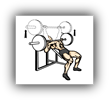
While that’s a pretty good guideline, the conclusive way to determine the correct grip for you is to make sure that your forearms stay in the vertical position throughout the lift. Your elbows are always directly under your wrists. If your grip is too wide, you’re putting a great deal of stress on your shoulders where they attach to your pecs. If it’s too narrow, you’re not going to be able to lower it all the way to your chest.
Never use a false grip on the incline; make certain that your thumbs are wrapped around the bar. Some contend that the false grip, with thumbs under the bar, lets them apply more pressure to the bar. Maybe-although I doubt it-but using a false grip is just too dangerous. With the bar traveling over your face, maintaining a secure grip is essential. One slip, and you’ve got serious problems. It just isn’t worth the risk.
In addition to the safety factor, which is major, the false grip encourages you to cock your wrists. That is a form mistake. The wrists must stay locked. When you twist or cock them, you’re diluting power. Any movement of the wrists during the lift is also quite stressful to those small joints. So learn to use the secure grip from the very beginning. If you find that you have a tendency to move your wrists, even a little, start taping them. That serves a couple of purposes. It helps to support your wrists and is a reminder to keep them straight.
That takes care of your hands. Now for your feet. Many lifters merely sit on an incline bench and let their feet dangle or lightly touch the floor. To handle heavy weights on the incline, you must establish a solid foundation on the bench and that starts with your feet. Don’t just place your feet on the floor. Drive them forcefully into the floor. Sit back on the bench and tighten your legs, glutes, back and shoulders. Squeeze down into the bench and become part of it.
When the heavy weights stick, you can bring power up from your feet through your body and into the reluctant bar, but it’s possible only if you have a firm base.
A spotter is necessary for this exercise because the bar is over your face and throat the entire time. On many benches the uprights are behind the lifter’s head, making it nearly impossible for him to take the bar off them without assistance. The spotter needs to be alert at the two highest-risk points, when the bar is taken from the uprights and when it’s being racked after the set.
Make sure you’re in sync with your spotter. After you’ve locked into position on the bench and gripped the bar, count one, two, three, and press against the bar as he helps you remove it from the uprights. Don’t let him do all the work. When he releases the weight, it will feel extra heavy and not in the proper position. When you complete your set, be absolutely positive that he has control of the weight before you reduce the pressure on the bar or let go of it. Never throw the bar backward into the uprights. It can rebound out before even the quickest spotter can grab it.
The lifter and spotter must communicate and not assume. When the spotter hands you the bar and you have it locked out, tell him to let go. When you know that a difficult rep is your last, even though you planned on doing more, tell him to take the bar. Once he has the weight secured, the spotter should say, “I’ve got it.”
The spotter has helped you take the weight from the uprights and you have it locked out overhead and are ready to do your first rep. Instead of just holding the bar in a passive manner, push up against it and make sure it’s in the correct starting position before you start the movement. Staying rigidly tight, pull the bar downward to the point on your chest where your collarbones meet your breastbone. When you think about pulling the bar into position rather than just lowering it, you’ll maintain much better control of it. The bar must be lowered in a correct line in order for the upward line to be accurate.
If you’ve done only flat benches, you’ll have to practice touching the bar at the higher position. At first it will feel quite strange, but stay with it because you’ll never be able to handle heavy weights unless you set the bar high on your chest.
Pull the bar to the right place on your chest, pause a brief moment and then drive it upward in a straight course. It should pass close to your chin and forehead. Throughout the lift your elbows will stay down and out, away from your body. They never tuck in close to your body, as they do when you do flat benches.
<< Previous Next >>


