Last Update On November 13, 2011
The Bench Press Vs. The Incline Bench Press
by Bill Starr
Page 4
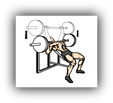
As you accept the bar from your spotter, take a deep breath and hold it until you’ve pressed the bar through the sticking point. I’ve said it many times before, but I’ll say it again: If you exhale or inhale during the execution of any pressing exercise, you’re diminishing your power base. The up-and-down movement takes only a few seconds, so there’s no risk of running out of air.
Lock the bar out at the finish, breathe, hold it and do the next rep. Again, I caution you not to rebound the bar off your chest. If you try to, the bar will run forward, and with heavy weights there’s no way to pull it back in the proper line. If you pause on your chest from the very beginning, you’ll always be able to maintain that form, even with the heaviest weights.
While learning this lift, your initial move off your chest should be deliberate and not too fast. After a few weeks you can start exploding the bar off your chest, making certain you drive it in the correct line. The dynamic start will get the bar moving with more speed and should carry it to the top of your head. That’s the sticking point for most. What typically happens is that lifters are concentrating so much on a powerful start, they forget about the middle. As soon as you drive the bar off your chest, follow through immediately so that there’s no hesitation at all. If you learn how to propel the bar off your chest and instantly continue with a dynamic middle, the bar will sail through the sticking point and the finish will take care of itself.
Start with the basic five sets of five. Once you master the technique, change your set-and-rep sequence each time. Do five sets of five with a back-off set of 10; three sets of five followed by two or three sets of three and a back-off set of 10; and three sets of three followed by three singles with a back-off set of 10. That’s for those who want to do inclines only once a week. Many of my lacrosse players at Hopkins worked inclines twice and the flat bench once a week. If that’s what you do, use the formula I just laid out on your heavy day, and do five sets of eight at the second incline session of the week.
Should you be fortunate enough to have an adjustable incline bench, alter the angle regularly. For Olympic lifters, shot-putters and basketball and volleyball players, the steeper you can set the incline, the better.
I also like doing inclines with dumbbells. They add another dimension to training the shoulders because they require more control than a bar. That means the attachments are involved more, and that’s desirable for every athlete, since tendons and ligaments are what secure the joints.
I use dumbbell inclines as an auxiliary exercise and generally include them on the bench press or overhead press days. I use higher reps for two to three sets and adhere as closely as possible to the 40-rep rule. This equals two sets of 20, three sets of 12 or 15.
The technique for handling dumbbells is quite different from the one you use on the bar, though you still want to plant your feet and squeeze into the bench. Drive the ’bells close to your head, and don’t let them wander out to the sides, which is what they always try to do. They also enjoy running forward. Concentrate on pressing them in a straight line until they move past your head. Then guide them toward each other so that they touch at the finish.
Lower them back to your shoulders in a controlled manner. Lowering them out of control will result in some dinged shoulders, and that action will throw them out of position for the next rep. As I suggested for inclines done with a bar, change the angle on the bench at regular intervals.
Strong shoulders and arms are valuable for any athlete, and the incline-bench press is the very best exercise for helping you achieve that goal and for becoming a more proficient athlete. If you’ve never done inclines, you’re in for a pleasant surprise.
<< Previous


